An articulated steel bagh nakh
All subject photos
Museum: Feldman Family Museum
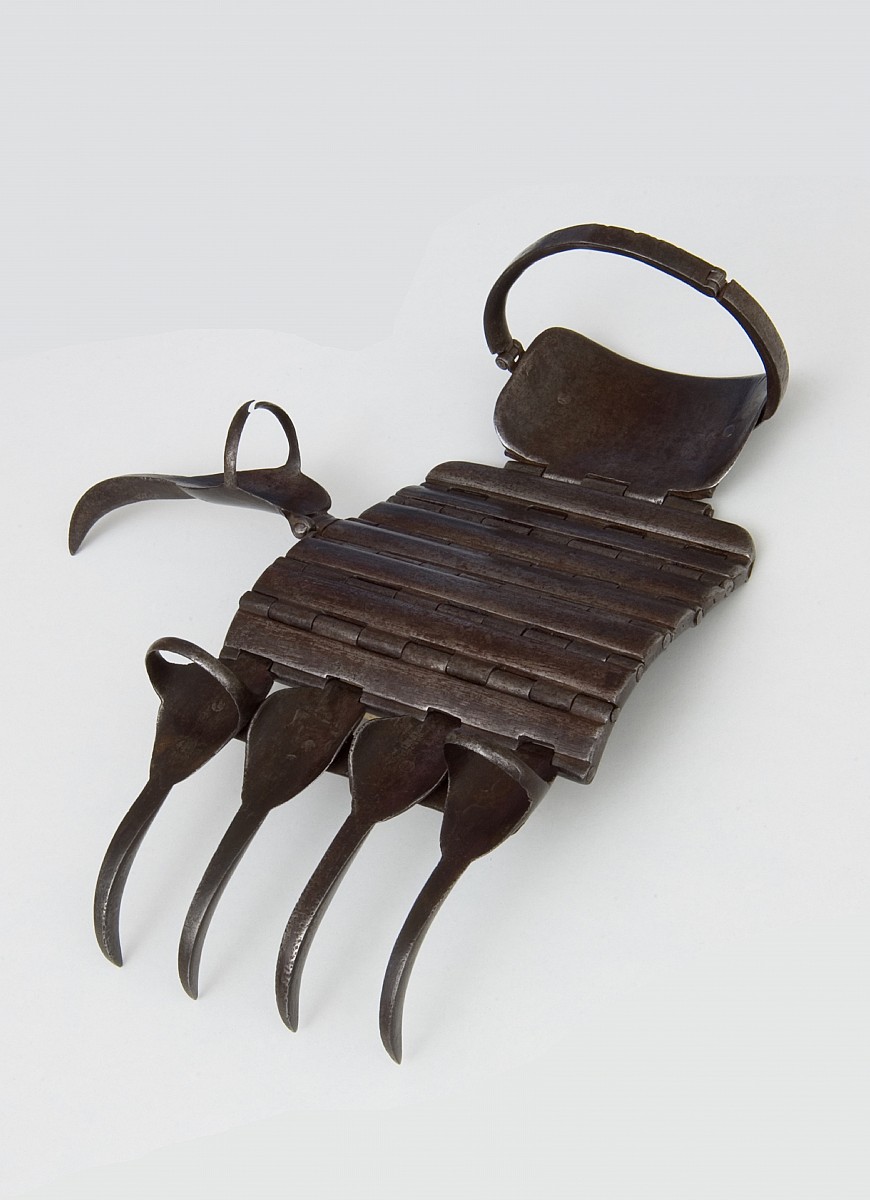
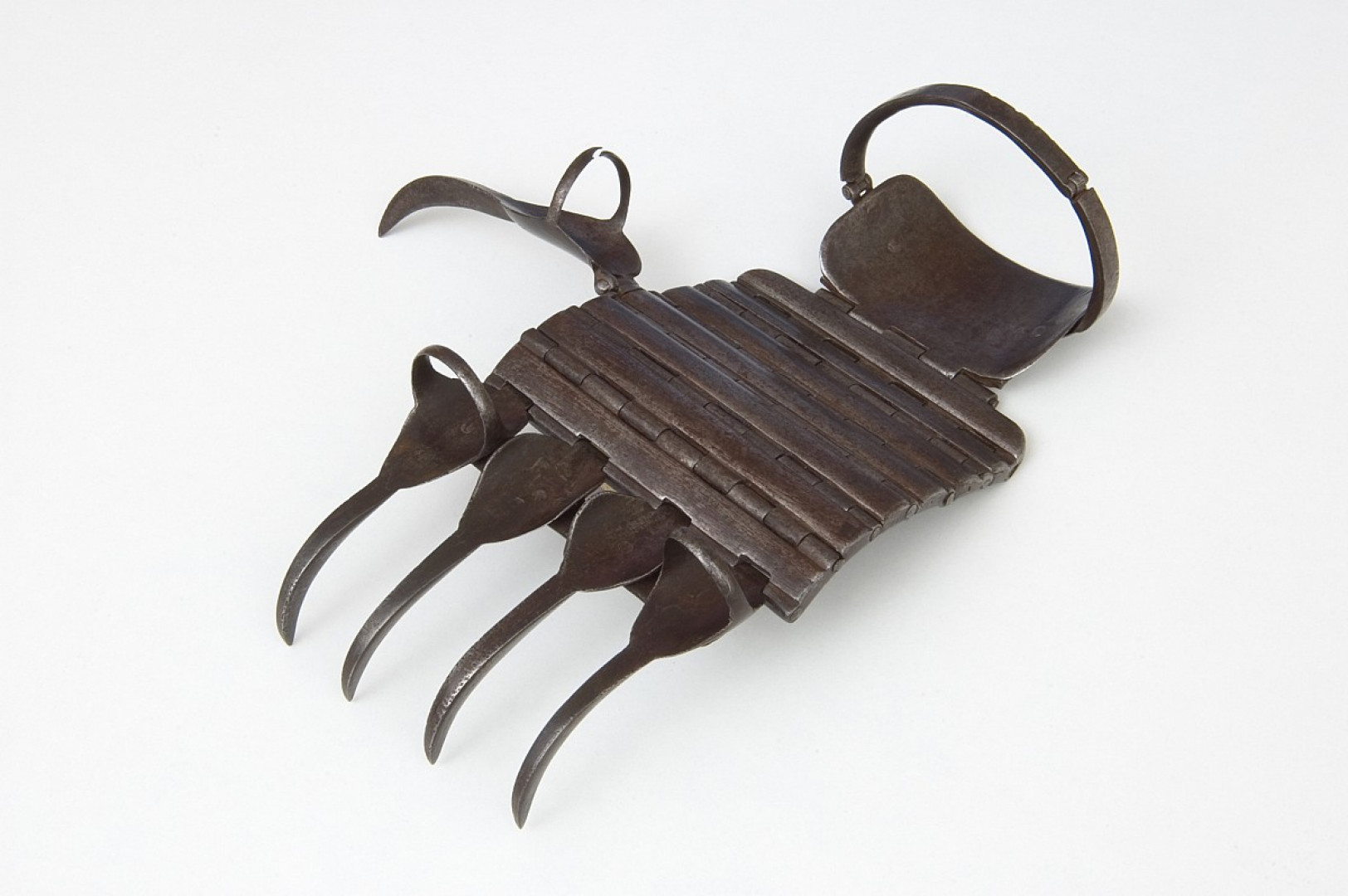
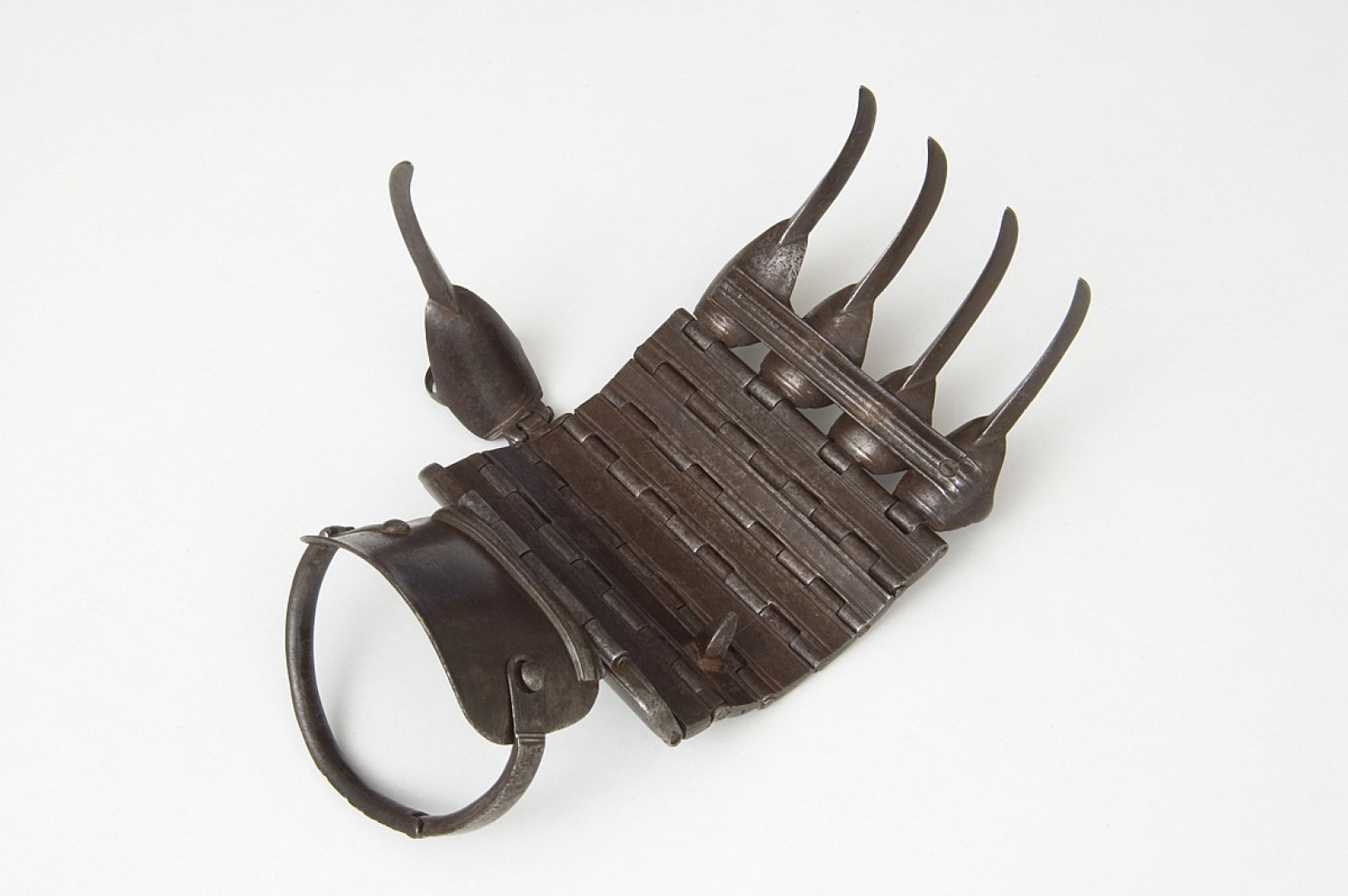
The palm consists of hinged seven plates one of that is engraved with the short inscription “Mul Ram”. All five claws are also hinged, and three of them are fitted with retaining rings for the thumb, index finger and little finger. A transverse strip rigidly joins the four lower claws together. In addition, there is a hinged upper plate provided with a thin clamp to fasten it on the wrist.
COMMENT. Bagh nakh is the Indian hand-fighting slashing weapon, which consists of several miniature curved blades resembling claws. The name means "tiger’s claw" in Hindi. The bagh nakh was usually manufactured of steel. In its simplest form, it is a narrow plate with firmly attached blades and two side rings for the index finger and little finger. In turn, each ring could be complemented by a short double-edged blade or a pointed spike on the outside. The bagh nakh was a favorite weapon of robbers and assassins as it can easily be hidden in the fist. The most complicated but least common bagh nakh type was the articulated metal glove with five claw-shaped blades.
This example represents an extremely rare type of bagh nakh created as an articulated steel glove with claws. Anthony C. Tirri uses the name "nakha dasti" for a similar Indian hand-fighting weapon (see Tirri, A.C. Islamic Weapons: Maghrib to Moghul. – Miami, 2003. – P. 310, fig. 229). The presented example is intended for the left hand and is paired most likely with an articulated steel bagh nakh for the right hand published in the catalogue of the Lord Egerton's collection as a Maratha weapon from Sattara (see Egerton, W. A Description of Indian and Oriental Armour: Illustrated from the Collection Formerly in the India Office Now Exhibited at South Kensington and the Author's Private Collection: With a Map, Twenty-three Full-page Plates (two Coloured), and Numerous Woodcuts with an Introductory Sketch of the Military History of India. – London, 1896. – P. 115, pl. 10, no. 477). Undoubtedly, this is about Satara, a city in Central India, which was for some time the capital of the Maratha Confederacy (1764-1818) and now is part of the state of Maharashtra.
LITERATURE: 1) Hales, R. Islamic and Oriental Arms and Armour: A Lifetime’s Passion. – London, 2013. – P. 75, no. 161; 2) Сиваченко Е. Сталь и Золото: Восточное оружие из собрания Feldman Family Museum = Steel and Gold: Eastern Weapons from the Feldman Family Museum Collection. – Киев, 2019. – С. 622-623, №215.